Backend development services cover the server-side logic, APIs, databases, and infrastructure that make your app or website actually work behind the scenes. A backend development company designs this system, builds the APIs and microservices that connect it to your frontend and third-party tools, and architects it so it holds up as usage grows, rather than breaking the first time traffic spikes.
If you are scoping backend work and trying to figure out what “good” looks like, or whether Node.js or Python fits your product better, this guide covers it in plain terms.
What do backend development services actually include?
“Backend development” gets used loosely, so it helps to break it into what actually gets built:
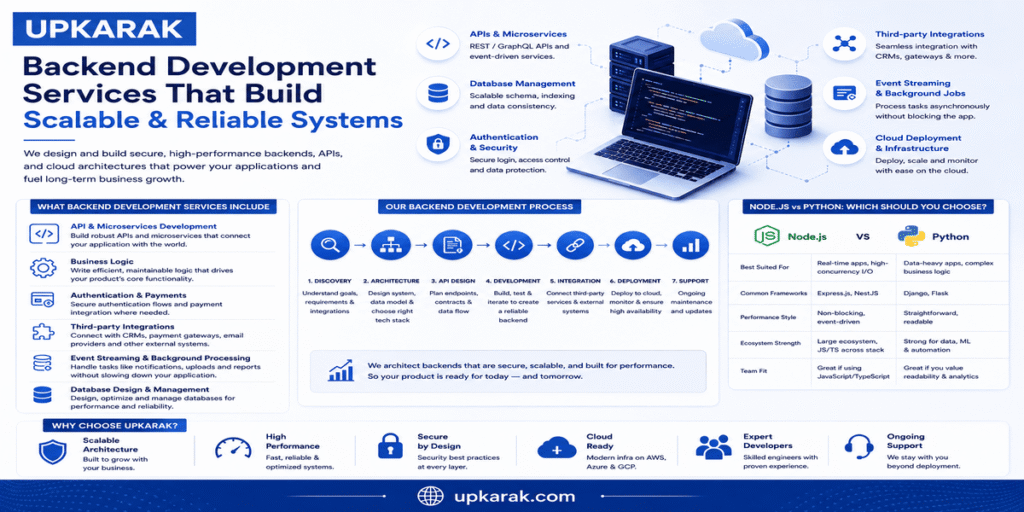
- API and microservices development. REST or GraphQL endpoints and event-driven services that let your frontend, mobile app, or partner systems talk to your data and logic.
- Business logic. The rules that decide what happens when a user places an order, submits a form, or triggers a workflow.
- Authentication and payments. Secure login, access control, and payment processing where needed.
- Third-party integrations. Connecting to CRMs, payment gateways, or other external systems your business already runs.
- Event streaming and background processing. Work that happens asynchronously, like sending notifications or processing uploads, without blocking the main application.
- Database design and management. Structuring how data is stored, indexed, and kept consistent as it grows.
A full backend development engagement covers all of this, not just writing code against a spec.
What a backend development company does, step by step
Phase | What happens | Typical output |
Discovery | Requirements gathering, review of expected load and integrations | Technical requirements document |
Architecture | System design, data modeling, choice of stack and services | Architecture diagram, tech stack decision |
API design | Endpoint planning, request and response contracts | API specification |
Development | Building the logic, APIs, and database layer | Working backend codebase |
Integration | Connecting third-party tools and services | Tested integrations |
Testing | Load testing, security testing, bug fixes | QA report |
Deployment and support | Cloud deployment, monitoring, ongoing maintenance | Live, monitored system |
Node.js vs Python for backend development: which fits your project?
This is one of the most common questions we get asked before a project even starts scoping. Neither is universally “better,” they are suited to different workloads.
Factor | Node.js | Python |
Best suited for | Real-time features, high-concurrency I/O (chat, live updates, streaming) | Data-heavy logic, complex business rules, apps close to data science or automation |
Common frameworks | Express.js, NestJS | Django, Flask |
Performance style | Non-blocking, event-driven, handles many simultaneous connections efficiently | Straightforward, readable, strong for logic-heavy processing |
Ecosystem strength | Large package ecosystem, shares language with frontend JavaScript/TypeScript | Strong libraries for data processing, automation, and machine learning integration |
Team fit | Good if your frontend is already JavaScript/TypeScript, one language across the stack | Good if your team values readability or expects to add data science or automation later |
In practice, a lot of products do not need a philosophical debate here. If your frontend is already JavaScript and you expect real-time features, Node.js usually reduces friction. If your roadmap includes heavier data processing, Python tends to fit more naturally. For teams already invested in the Microsoft or Java ecosystem, .NET and Java remain solid choices too, the right call depends on your existing team and infrastructure as much as the workload itself. A short technical discovery call is a faster way to get a real answer than reading stack comparisons.
API development services: REST, GraphQL, or event-driven?
Most API development services default to REST because it is simple, cacheable, and well understood by nearly every client and integration partner. GraphQL becomes worth considering when your frontend needs to pull very specific, nested data in a single request, such as a dashboard pulling from many related resources at once. Event-driven and streaming architectures matter when parts of your system need to react to things happening elsewhere, like updating inventory the moment an order is placed, without every service being directly wired together. Most systems end up using a mix, REST for straightforward client requests, with event streaming handling the background coordination between services.
What scalable backend architecture actually requires
“Scalable” gets used as a buzzword, so it is worth being specific about what it means in practice:
- Microservices where they earn their complexity. Breaking a system into services makes sense once a single codebase becomes a bottleneck for the team, not before.
- Caching. Frequently requested data gets served from cache (Redis is a common choice) instead of hitting the database every time.
- Database scaling. Indexing, replication, and connection pooling so the database does not become the bottleneck as traffic grows.
- Search and analytics pipelines. For data-heavy products, a dedicated search layer (Elasticsearch is a common choice) keeps complex queries fast without straining the primary database.
- Load balancing and containerization. Traffic gets distributed across multiple instances instead of overloading one, typically run through Docker-based deployments.
- Monitoring and alerting. Problems get caught before users notice, not after.
This is where backend development and infrastructure work overlap heavily. Our DevOps and cloud services cover the CI/CD pipelines and AWS/Azure infrastructure side of this, while the backend team handles the application-level design that makes scaling actually work rather than just theoretically possible. On the data side specifically, our database management services handle the schema design, query optimization, and high-availability setup that keeps performance stable as data volume grows.
Signs your business needs a backend development company
- Your current system cannot handle traffic spikes without slowing down or falling over
- Adding a new feature means untangling logic that was never designed to be extended
- You are manually doing work that should be automated through an API integration
- Your database queries have gotten slow enough that pages visibly lag
- You are relying on a no-code or low-code tool that has hit its ceiling
- Multiple teams or products need to share data and logic that currently lives in one tangled codebase
What drives the cost of backend development services
Cost depends on scope more than anything else. The main drivers are:
- Number and complexity of APIs. A handful of simple endpoints costs far less than complex business logic with many edge cases.
- Data volume and structure. Large or highly relational datasets need more careful architecture and testing.
- Integration count. Every third-party system (payments, CRM, analytics) adds scoping and testing time.
- Real-time and event-driven requirements. Live updates, streaming, or background processing add architectural complexity.
- Compliance needs. Handling payment data or regulated information adds security and audit work.
- Chosen stack and team availability. Whether the work fits your existing team’s stack or needs new expertise affects both timeline and cost.
Because of these variables, most backend development companies price by scope after a discovery call rather than by a flat rate.
How to choose the right backend development company
- Do they ask about your expected scale and growth plans, or only about the current feature list?
- Do they explain trade-offs (like Node.js vs Python, or REST vs event-driven) instead of defaulting to one stack regardless of fit?
- Can they show experience with systems of similar complexity to what you are building?
- Do they build in monitoring and load testing, or treat those as optional extras?
- Do they cover the infrastructure and database side too, or only the application code, leaving you to coordinate three vendors?
- Do they support the system after launch, or hand it off and disappear?
Common mistakes to avoid
- Designing the database as an afterthought. Retrofitting a data model after the API is built is expensive and error-prone.
- Skipping load testing. A backend that works fine with ten test users can fail badly under real traffic.
- Reaching for microservices too early. Splitting a small, simple system into services adds operational overhead before it adds any real benefit.
- Ignoring API versioning. Changing an API without a versioning plan breaks every client that depends on it.
- Choosing a stack based on trend rather than fit. The newest framework is not automatically the right one for your team or workload.
A typical scenario
To make this concrete: a growing SaaS product often comes to us with a backend that was built quickly to launch, where product and billing logic are tangled together in a way that made every new feature slower to ship than the last. A focused engagement in a case like this usually starts with separating that logic into clean services, redesigning the database schema around how the product actually queries it, and adding caching in front of the most frequently hit endpoints. The change the team notices first is not the architecture diagram, it is that a feature that used to take two weeks to ship safely now takes three or four days. This is an illustrative pattern common to growth-stage backend engagements, not a specific named client case.
FAQs
What is included in backend development services?
API and microservices development, business logic, authentication and payments, third-party integrations, event streaming and background processing, and database design and management.
Should I choose Node.js or Python for my backend?
Node.js tends to fit real-time, high-concurrency applications well, especially if your frontend is already JavaScript. Python tends to fit data-heavy or logic-heavy applications well, especially if you expect to add automation or data science later. Many projects work well on either, so team fit and roadmap matter as much as raw technical differences.
What is the difference between REST, GraphQL, and event-driven APIs?
REST is simpler, cacheable, and well understood by most integration partners, and is the right default for most client-facing requests. GraphQL is worth considering when a frontend needs specific nested data in a single request. Event-driven architectures matter when services need to react to changes elsewhere in the system without being tightly coupled.
How do I know if my backend needs to be more scalable?
Common signs are slowdowns during traffic spikes, database queries that have gotten visibly slower, and features that take longer to build because the existing logic was never designed to be extended.
How much do backend development services cost?
Cost depends on the number and complexity of APIs, data volume, integration count, real-time requirements, compliance needs, and the chosen stack. Most backend development companies price by scope after a discovery call rather than a flat rate.
Do you offer ongoing support after the backend is built?
Yes. Backend engagements typically include post-launch monitoring, maintenance, and support, since real usage patterns almost always surface small issues that only show up once the system is live.
Next step
If your current backend is starting to slow your team down, or you are scoping a new product and are not sure whether Node.js or Python is the right call, the fastest way to get a real answer is a short conversation. Contact our backend development team and we will walk through your requirements honestly, including whether you need a full rebuild or a smaller, targeted fix.