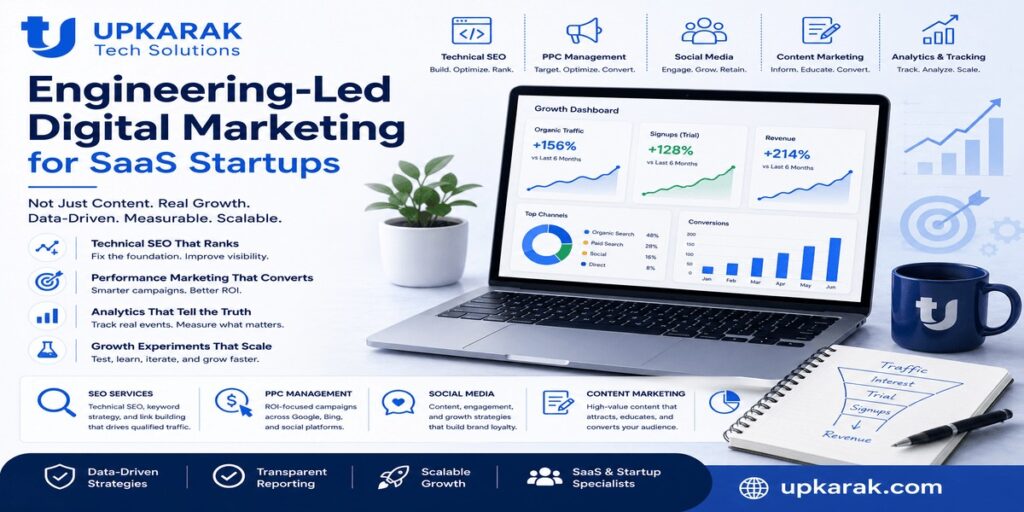
A generic digital marketing agency that posts on social media and publishes blog content without touching your analytics stack, event tracking, or actual product funnel will plateau fast on a SaaS product. What actually moves the needle is treating SEO, PPC, and content as engineering problems: properly instrumented in GA4 and Search Console, tied to real conversion events instead of platform-reported clicks, and tested through structured experiments rather than published and hoped for.
This matters more for technical products than for a typical local business, because a SaaS company’s real bottleneck is usually not traffic. It’s whether that traffic gets tracked accurately and whether it converts into trial signups or revenue anyone can actually measure.
Quick Answer at a Glance
Your situation | What you actually need |
Traffic exists but isn’t tied to signups or revenue | A digital marketing agency that fixes analytics and attribution before running new campaigns |
Organic rankings stuck despite regular content | An SEO services company that audits technical SEO, not just content volume |
Ad spend without clear ROI per channel | A PPC management agency that connects ad platforms to real conversion events |
Early-stage startup validating channels | A digital marketing consultant who can run structured experiments before you commit to a full team |
Social presence exists but isn’t converting | Social media marketing services wired into funnel tracking, not run in isolation |
Blog exists but doesn’t drive signups | A content marketing agency writing to answer real buyer questions tied to your product |
What “Technical” Digital Marketing Actually Means
Most agencies describe their work in marketing language. An engineering-led team describes it in terms of what’s actually instrumented and measured.
Pillar | What it involves | Common tools |
Technical SEO and performance marketing | Site speed, crawlability, structured data, and search visibility fixes at the code level | Search Console, Core Web Vitals reports |
Analytics, attribution, and conversion tracking | Wiring every channel to real product events, not just page views | GA4, Segment |
Growth experiments and A/B testing | Structured tests on landing pages, pricing pages, and onboarding flows | Meta Ads, Google Ads, in-product experimentation tools |
Our services overview covers how these three pillars connect to the rest of a product build, since marketing and engineering decisions affect each other more than most agencies admit.
A Technical SEO Checklist Before You Pay for a Full Campaign
Before committing a budget to new content or link building, confirm these are actually in order. Most ranking problems trace back to one of these, not a lack of blog posts.
- Crawlability: confirm search engines can actually reach and index your key pages, not just your homepage.
- Core Web Vitals: check load speed and layout stability, since slow pages get demoted regardless of content quality.
- Structured data: add schema markup so search engines and AI systems can parse your pages correctly, not just guess at context.
- Canonicalization: fix duplicate URL variants (with and without trailing slashes, tracking parameters, and so on) that split your ranking signals.
- Mobile rendering: confirm the mobile version renders and performs the same way the desktop version does.
- Internal linking: check that important pages are actually reachable within a few clicks from your homepage, not orphaned in a sitemap.
Why Attribution Matters More Than Traffic
A digital marketing agency reporting rising traffic numbers isn’t the same as one reporting rising signups. Without proper conversion tracking, a PPC management agency can report a growing click count while your actual trial signups stay flat, and nobody catches it until the quarterly numbers don’t add up.
Fixing this usually means wiring GA4 and a customer data platform like Segment to your actual product events (signup completed, trial started, plan upgraded), not just pageviews. Once that’s in place, you can finally tell whether a channel is working or just generating activity that looks like progress.
Digital Marketing for SaaS Startups: Why It’s a Different Problem
Marketing a SaaS product isn’t the same problem as marketing a local business, because the goal isn’t just visibility, it’s getting the right kind of user into a product funnel that changes shape as the product evolves. A landing page that converts well in month one can quietly stop converting once your onboarding flow changes, and most standalone marketing vendors never notice because they aren’t looking at the product side at all.
This is also why marketing decisions and architecture decisions end up connected more often than people expect. If you’re scaling past your first few customers, our piece on designing multi-tenant SaaS that scales to a million users covers the kind of product-side changes that quietly break marketing funnels if nobody’s watching for them.
Running Growth Experiments Like Product Features, Not Marketing Guesses
Treat every PPC, content, or social experiment the way you’d treat a product feature.
- Write a specific hypothesis before you launch anything, not just “let’s try video content.”
- Define the metric that decides success in advance, and make sure it’s tied to a real conversion event, not impressions.
- Run the test long enough to reach a meaningful sample size before calling a winner. Killing a test after three days of low traffic tells you almost nothing.
- Document what you tested and the result, whether it worked or not, so the next experiment doesn’t repeat the same mistake.
Why an Engineering-Led Team Approaches This Differently
Most marketing vendors can write content or run ad campaigns. Fewer can actually go fix the tracking, the site speed, or the schema markup themselves, because they don’t have engineers on staff. Working with a team that’s been building software products since 2016, with more than 50 engineers and over 100 products delivered, means the same team that can diagnose a tracking gap can also fix it in the codebase, instead of filing a ticket and waiting on someone else’s roadmap. As one client put it: the team is reliable and thorough about actually meeting requirements, not just presenting a plan. You can see how this plays out across different product types on our about page.
When a Consultant Is Enough vs When You Need a Full Team
A digital marketing consultant can audit your current setup, flag what’s broken, and recommend a direction, usually in a few hours a week. That’s often enough at the very early stage, when you’re still deciding which channel to focus on.
Once the fix involves actually rebuilding tracking, patching technical SEO issues in your codebase, or running continuous experiments across multiple channels, you need people who can execute, not just advise. That’s the point where a consultant’s recommendations start piling up faster than one person can implement them, and a full team becomes the cheaper option in practice.
Frequently Asked Questions
What makes a digital marketing agency different for a SaaS product versus a local business?
A SaaS product’s bottleneck is usually accurate tracking and conversion, not just visibility. A SaaS-focused agency should wire marketing channels directly into your product’s real conversion events, not just report on traffic and clicks.
What does technical SEO actually check for?
It covers whether search engines can crawl and index your pages, how fast your pages load, whether structured data is present, and whether duplicate URLs are splitting your ranking signals, separate from how much content you publish.
How is a PPC management agency’s job different when ad platforms self-optimize bids?
When ad platforms handle bidding automatically, the manager’s real value shifts to campaign structure, audience targeting, and making sure conversions are tracked accurately, since automated bidding is only as good as the conversion data feeding it.
Should an early-stage startup hire a digital marketing consultant or a full team?
A consultant works well for an initial audit and direction while you’re still deciding which channel to focus on. Once fixes require ongoing execution, tracking rebuilds, or continuous experiments, a full team becomes more efficient.
Does content marketing matter if a SaaS product already has decent traffic?
Traffic without conversion tracking tells you little. Content marketing works best when it answers real buyer questions tied to your product and is measured against actual signups, not just pageviews.
What should social media marketing services include for a SaaS company?
Beyond a posting schedule, social activity should connect back to your funnel tracking so you can tell whether social traffic actually converts, rather than judging success by engagement numbers alone.
Final Recommendation
Before choosing a digital marketing agency, an SEO services company, or a PPC management agency for a technical product, ask whether they can actually fix tracking and technical SEO issues themselves, or whether they’ll just flag problems for your engineering team to handle later. If you want that conversation with a team that builds product and marketing infrastructure together, you can get in touch here.