Introduction
Launching a SaaS product is relatively easy today. Modern frameworks, cloud providers, and AI-assisted development have significantly reduced the time required to build an MVP.
The real challenge begins after your first hundred customers.
As your customer base grows, you’ll encounter new problems:
- Database performance starts degrading.
- Infrastructure costs rise unexpectedly.
- Large enterprise customers demand data isolation.
- Noisy tenants affect everyone else’s performance.
- Deployments become risky.
- Scaling one service requires scaling everything.
This is why architecture matters from day one.
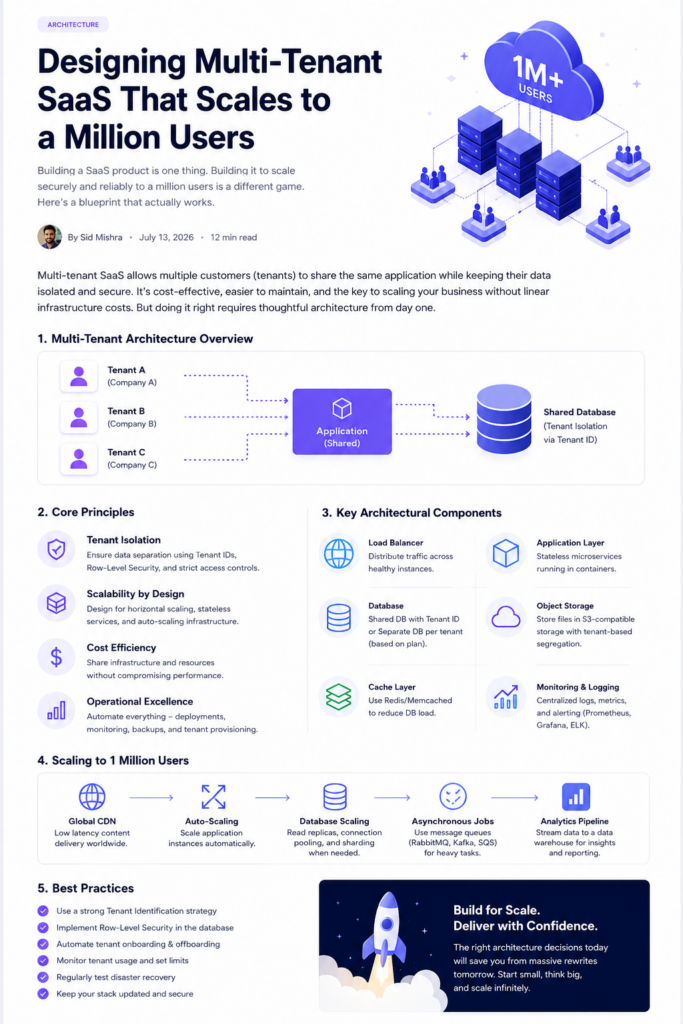
In this article, we’ll explore how to design a multi-tenant SaaS architecture capable of supporting one million users while remaining secure, maintainable, and cost-efficient.
What is Multi-Tenant SaaS?
A multi-tenant application serves multiple customers (called tenants) from the same application instance while keeping each customer’s data completely isolated.
Think about products like:
- Slack
- Notion
- Shopify
- HubSpot
- Jira
Although millions of companies use these products, they all run on shared infrastructure.
Every company has:
- its own users
- permissions
- settings
- billing
- files
- workflows
Yet everything is powered by one scalable platform.
Why Multi-Tenant?
Instead of creating one application per customer, you maintain a single platform.
Benefits
- Lower infrastructure costs
- Easier maintenance
- Faster deployments
- Shared updates
- Better resource utilization
- Simplified monitoring
However, multi-tenancy introduces challenges that must be addressed early.
Architecture Overview
The typical architecture looks like this: