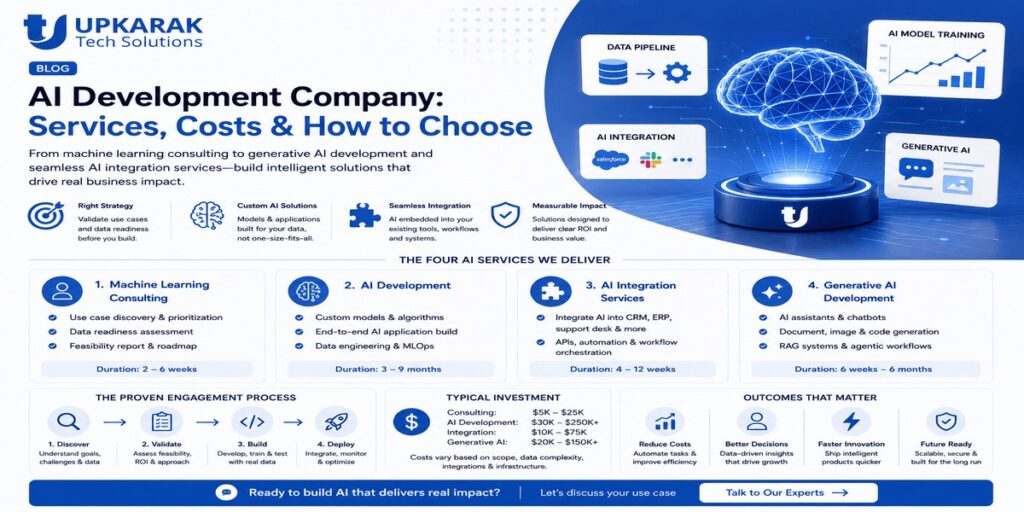
AI development companies build intelligent solutions using machine learning, generative AI, and automation technology. Most businesses see 30-50% productivity gains within 6 months of AI integration. Choosing the right AI development partner depends on technical expertise, industry experience, and understanding your specific use case (chatbots, predictive analytics, automation, or custom AI models).
What AI Development Companies Actually Do
The term “AI development company” encompasses multiple specialized services. Understanding what they offer helps you evaluate whether you need a partner and what capabilities matter most.
AI Development Services Overview
AI development companies deliver diverse solutions across three primary domains: software enhancement, strategic automation, and new AI-native products.
Software Enhancement through AI:
- Adding AI features to existing products (chatbots, recommendations, search optimization)
- Integrating large language models (LLMs) into applications
- Implementing predictive capabilities
- Automating manual workflows
Strategic Business Automation:
- Business process automation (RPA)
- Intelligent document processing
- Customer service automation
- Supply chain optimization
AI-Native Product Development:
- Building products designed around AI from inception
- Creating proprietary machine learning models
- Developing specialized AI solutions for specific industries
- SaaS platforms powered by generative AI
Machine Learning Consulting vs AI Development
Many businesses confuse these roles. Understanding the distinction prevents hiring the wrong partner.
Machine Learning Consulting:
- Strategic advisory on AI viability
- Proof-of-concept development
- Technology recommendations
- Risk assessment and roadmap planning
- Training and capability building
Best for: Organizations exploring AI possibilities, uncertain about implementation, or needing guidance before committing to full development.
AI Development Companies:
- Full-cycle product engineering
- Production-grade AI system implementation
- Integration with existing infrastructure
- Ongoing maintenance and optimization
- Continuous model improvement
Best for: Organizations ready to deploy AI solutions, needing operational implementation, or requiring sustained partnership.
Reality for most businesses: Start with ML consulting to explore possibilities, then engage AI development for implementation and scaling.
Understanding Generative AI Development and LLM Integration
Generative AI has transformed what’s possible with artificial intelligence. Understanding this technology category helps you evaluate whether it suits your business.
What is Generative AI?
Generative AI systems create new content, predictions, or solutions based on patterns learned from training data. Unlike traditional software with predefined outputs, generative AI produces unique responses to inputs.
Common generative AI applications:
- Text generation (ChatGPT-style interfaces)
- Image generation (DALL-E, Midjourney)
- Code generation (GitHub Copilot)
- Data analysis and summarization
- Personalized recommendations
- Content creation and editing
Large Language Models (LLMs) and Integration
Large Language Models (LLMs) are the technology backbone of most modern generative AI applications. Understanding LLM integration helps you appreciate what’s technically possible.
Popular LLM platforms:
Platform | Best For | Key Strengths | Cost Model |
OpenAI GPT-4 | General-purpose tasks | Most capable, versatile | Pay-per-token |
Claude 3 (Anthropic) | Long-context reasoning | Constitutional AI, safer outputs | Pay-per-token |
Google Gemini | Search integration, multimodal | Google ecosystem access | Pay-per-token |
Open-source (Llama, Mistral) | Privacy-sensitive applications | No API fees, full control | Self-hosted |
Specialized models | Industry-specific tasks | Domain expertise built-in | Varies |
LLM Integration approaches:
- API Integration: Connect to hosted models (OpenAI, Anthropic, Google)
- Pros: Quick deployment, no infrastructure needs
- Cons: Dependency on external providers, ongoing API costs
- Timeline: 1-2 weeks typically
- Fine-tuning Existing Models: Customize pre-trained models with your data
- Pros: Better performance on specific tasks, improved accuracy
- Cons: Requires quality training data, higher computational cost
- Timeline: 4-8 weeks
- Custom Model Development: Build models from scratch for specialized needs
- Pros: Full control, optimized for exact requirements
- Cons: Expensive, time-consuming, requires data and expertise
- Timeline: 3-6 months minimum
Generative AI Development Services
Modern AI development companies offer comprehensive generative AI services:
Chatbot and Conversational AI:
- Customer service automation
- Internal knowledge assistants
- Sales and support automation
- Real-time problem resolution
Content and Document Processing:
- Summarization and analysis
- Document classification
- Information extraction
- Report generation
Code and Technical Solutions:
- Software development assistance
- Code review and optimization
- Technical documentation generation
- Test case creation
Creative and Design Applications:
- Copywriting and content creation
- Image generation for marketing
- Design ideation
- Product descriptions
Data and Analytics:
- Pattern recognition in complex datasets
- Predictive analytics
- Anomaly detection
- Business intelligence automation
How AI Integration Services Work in Practice
AI integration involves embedding intelligence into existing systems. Understanding the process helps you evaluate whether integration makes sense for your business.
AI Integration Process
Phase 1: Assessment and Planning (2-3 weeks)
- Audit existing systems and data
- Identify integration opportunities
- Define measurable success metrics
- Assess infrastructure requirements
- Estimate costs and timeline
Phase 2: Proof of Concept (4-6 weeks)
- Develop small-scale prototype
- Test with real data
- Measure performance
- Validate business assumptions
- Build stakeholder confidence
Phase 3: Development and Integration (8-16 weeks)
- Full system architecture design
- API and data pipeline development
- Model training with your data
- Testing and optimization
- Security and compliance implementation
Phase 4: Deployment and Monitoring (2-4 weeks)
- Staged rollout (limited users first)
- Real-time performance monitoring
- Issue resolution and adjustments
- Staff training and documentation
- Transition to operational phase
Phase 5: Optimization and Scaling (Ongoing)
- Model performance monitoring
- Continuous retraining with new data
- Feature enhancements
- Infrastructure scaling
- ROI measurement and reporting
Common AI Integration Challenges and Solutions
Challenge | Why It Happens | How Good Partners Address It |
Data Quality Issues | Real-world data is messy | Data audit and cleaning pipeline |
Model Performance Drift | Data changes over time | Monitoring and retraining protocols |
Integration Complexity | Legacy systems incompatible | Middleware and API development |
Change Management | Staff resistance to new tools | Training and phased implementation |
Cost Overruns | Underestimated complexity | Clear scope definition, milestone tracking |
Security Concerns | AI systems access sensitive data | Encryption, access controls, compliance |
Real ROI: What Businesses Actually Achieve with AI
Understanding realistic outcomes helps you set appropriate expectations and evaluate AI development investments.
Documented Business Outcomes from AI Implementation
Customer Service Optimization:
- 40-60% reduction in support costs
- 30% improvement in response time
- 50+ NPS point improvement in some cases
- Faster issue resolution through AI-assisted diagnosis
Sales and Marketing Enhancement:
- 25-35% increase in lead quality scoring accuracy
- 20-30% improvement in sales conversion rates
- 40% reduction in time spent on email and administrative tasks
- Better customer segmentation for targeted campaigns
Operations and Supply Chain:
- 20-30% inventory optimization improvements
- 15-25% reduction in logistics costs
- 30-40% faster demand forecasting
- Fewer stockouts and overstock situations
Financial Services:
- 50-70% faster loan processing
- 25-35% reduction in fraud losses
- 20-30% improvement in credit risk assessment accuracy
- 40-50% faster account opening processes
Healthcare Applications:
- 30-40% reduction in diagnostic time
- 25-35% improvement in treatment outcome predictions
- 50-60% reduction in administrative burden
- Better patient risk stratification
Manufacturing and Engineering:
- 20-30% reduction in defect rates through predictive maintenance
- 25-35% improvement in asset utilization
- 15-25% reduction in energy consumption
- Faster quality control through computer vision
Timeline to ROI
Most businesses see measurable returns within 6-12 months:
- Months 1-3: Implementation and integration (typically cost only, no returns yet)
- Months 3-6: Pilot phase showing early results, proof of value
- Months 6-9: Full deployment with measurable improvements, ROI becoming visible
- Months 9-12: Scaling optimizations, compounding benefits, clear ROI demonstrated
Choosing the Right AI Development Company
Selecting an AI development partner is critical. Poor choice wastes time and money. Here’s how to evaluate options systematically.
Essential Evaluation Criteria
Technical Expertise and Specialization:
- Check: Do they have actual AI/ML experience, not just web development rebranded?
- Verify: Have they successfully deployed AI solutions in production?
- Ask: Which LLM platforms and frameworks do they specialize in?
- Look for: Published research, open-source contributions, technical blog posts
Industry Experience:
- Matters because: Different industries have different AI challenges
- Healthcare AI has different requirements than e-commerce AI
- Insurance ML models solve different problems than logistics ML
- Ask for case studies in your specific industry
Project Scale Capability:
- Small projects (POC): Freelancers or small agencies sufficient
- Medium projects (₹25-75 lakhs): Established boutique AI firms
- Large projects (₹75 lakhs+): Multi-team organizations with dedicated infrastructure
Technical Stack Alignment:
- Verify they use modern frameworks (TensorFlow, PyTorch, Hugging Face)
- Check cloud expertise (AWS, Azure, GCP)
- Ask about MLOps practices (monitoring, retraining pipelines)
- Ensure they understand data infrastructure
Client References and Proven Track Record:
- Demand references from similar-sized projects
- Verify project outcomes (not just “project completed”)
- Check case study details (timeline realism, challenges addressed)
- Call references and ask specific questions
Communication and Partnership Approach:
- Do they explain technical concepts clearly?
- How frequently do they provide updates?
- What’s their problem-resolution process?
- Do they treat you as partner or vendor relationship?
Red Flags When Evaluating AI Partners
Unrealistic promises:
- “We’ll have your AI ready in 2 weeks”
- “AI will immediately pay for itself”
- “We guarantee 90%+ accuracy” (accuracy depends on your data and problem)
Lack of depth:
- Generic presentations with no specific technology discussion
- Can’t explain how they’d solve YOUR problem specifically
- Portfolio shows unrelated work (web development tagged as AI)
- No technical discussion about architecture or approach
Poor communication:
- Vague timelines and milestone planning
- Unwillingness to share progress details
- No clear reporting or update schedule
- Defensive about technical questions
Limited experience:
- Few production AI deployments
- No references from actual AI projects
- Team mostly composed of web developers recently trained in AI
- No published content demonstrating expertise
Machine Learning Consulting: When You Need Strategic Guidance
Not every organization needs full AI development. Some benefit first from consulting to understand options and build strategy.
When Machine Learning Consulting Makes Sense
Exploration Phase:
- You know AI might help but unsure how specifically
- Want to understand realistic capabilities and limitations
- Need unbiased assessment before major investment
- Exploring whether to build, buy, or partner
Technical Evaluation:
- Comparing different AI approaches for your problem
- Need technology recommendations
- Building internal AI capability roadmap
- Evaluating buy vs build decisions
Pilot Project Evaluation:
- Want to validate assumptions before scaling
- Need guidance on data requirements and preparation
- Exploring cost-benefit before full commitment
- Building internal stakeholder buy-in
What Good ML Consulting Delivers
Strategic Assessment:
- Honest evaluation of AI feasibility for your challenges
- Realistic timeline and cost estimates
- Risk identification and mitigation strategies
- Technology and approach recommendations
Proof of Concept:
- Small-scale prototype demonstrating potential
- Working with your actual data
- Measurable results from pilot phase
- Clear path to full implementation
Roadmap and Planning:
- Phased implementation strategy
- Resource and budget requirements
- Skills and infrastructure needs
- Success metrics and measurement plan
Capability Building:
- Training for internal teams
- Documentation and knowledge transfer
- Process recommendations
- Self-sufficiency guidance
Machine Learning Consulting Costs
Engagement Type | Duration | Cost Range | Best For |
Strategic Assessment | 2-4 weeks | ₹2-5 lakhs | Understanding viability and options |
Proof of Concept | 4-8 weeks | ₹5-15 lakhs | Validating assumptions, pilot projects |
Technical Roadmapping | 1-2 weeks | ₹1-3 lakhs | Planning implementation path |
Full Consulting Engagement | 8-12 weeks | ₹15-40 lakhs | Comprehensive strategy and guidance |
Ongoing Advisory | Monthly retainer | ₹50k-2 lakhs/month | Continuous guidance and optimization |
The Future of AI Development: What’s Coming
Understanding AI development trends helps you make future-proof decisions today.
Emerging AI Capabilities Shaping 2026 and Beyond
Multimodal AI:
- Systems understanding text, images, audio, video simultaneously
- More natural interaction patterns
- Richer problem-solving capability
AI Agents and Autonomous Systems:
- AI making decisions without human intervention
- Complex multi-step task automation
- Collaborative AI and human workflows
Domain-Specific Models:
- Smaller, specialized models outperforming general-purpose systems
- Reduced infrastructure costs
- Better performance on specific problems
Real-Time AI:
- Instant AI responses (millisecond latency)
- Edge AI deployment (on device vs cloud)
- Continuous learning from user interactions
Responsible AI:
- Explainability and transparency requirements
- Bias detection and mitigation
- Regulatory compliance becoming standard
Strategic Recommendations for Planning AI Investments
- Start small, scale gradually: Pilot projects validate value before major investment
- Build internal capability: Partner with providers who train your team
- Plan for long-term relationships: AI is journey, not destination
- Prioritize domains with clearer ROI: Customer service, operations benefit most initially
- Invest in data infrastructure: Quality data determines AI success more than any other factor
Ready to Explore AI for Your Business?
AI development and machine learning consulting can transform how your organization operates. The challenge isn’t whether AI will help you, but whether you’ll implement it before competitors do.
The right AI development partner makes this journey clear, manageable, and profitable.
Next steps:
- Define your specific business challenge
- Understand AI’s realistic potential for your situation
- Evaluate whether to build, buy, or partner
- Engage with an experienced AI development company
- Start with proof of concept to validate assumptions
Schedule Free AI Strategy Consultation – Discuss your specific business challenges with AI experts and understand what’s possible.