Short answer: in India in 2026, most MVPs cost between ₹4 lakh and ₹18 lakh and take 6 to 14 weeks to build. A clickable prototype used purely for validation can be done for ₹1.5 lakh to ₹3 lakh. A complex MVP with multiple user roles, payments, regulated data or AI features runs from ₹18 lakh to ₹40 lakh and takes four to six months.
That spread is wide because MVP development cost is not really a price. It is the output of a scope decision. Two founders can describe “a marketplace app” in the same sentence and receive quotes six times apart, because one is building four screens and one is building forty.
This guide gives you the actual numbers, the levers that move them, and the questions to ask before you sign anything.
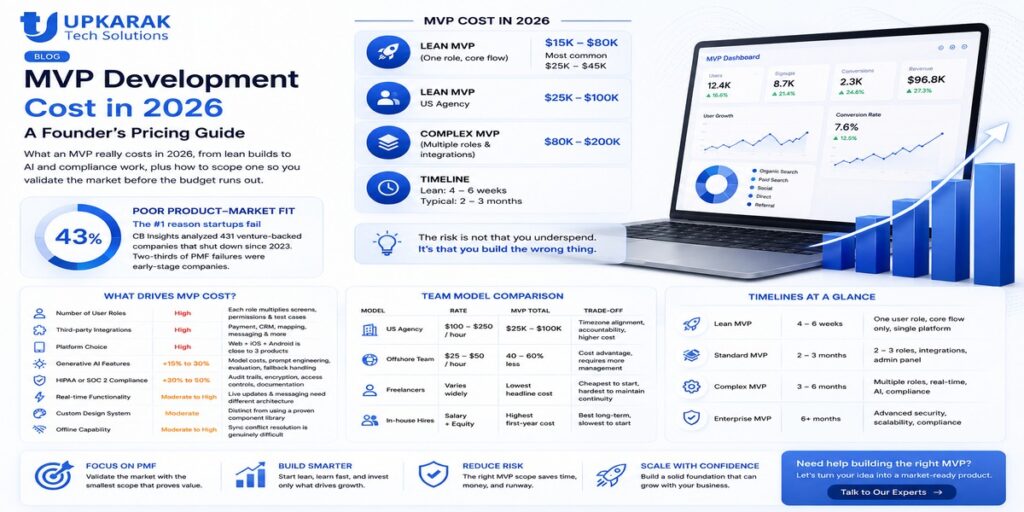
MVP development cost at a glance
MVP tier | What you get | Typical cost (INR) | Timeline |
Validation prototype | Research, UX flows, clickable Figma prototype. No working backend. | ₹1.5 lakh to ₹3 lakh | 2 to 3 weeks |
Lean MVP | One platform (web or mobile), 3 to 5 core features, auth, basic admin panel | ₹4 lakh to ₹8 lakh | 6 to 8 weeks |
Standard MVP | Web plus cross platform mobile, payments, notifications, analytics dashboard | ₹8 lakh to ₹18 lakh | 10 to 14 weeks |
Complex or regulated MVP | Multi role access, third party integrations, compliance requirements, AI or ML features | ₹18 lakh to ₹40 lakh | 16 to 24 weeks |
Add roughly 15 to 20 percent of build cost per year for hosting, monitoring, app store fees and post launch fixes. That line is missing from most budgets and it is the one that catches founders in month four.
If you want a number for your specific idea rather than a band, book a free consultation and we will scope it against these tiers.
What actually drives startup app development cost
Every quote you receive is built from the same four inputs. Understanding them lets you negotiate on scope rather than on rate, which is the only negotiation that protects quality.
1. Feature count and depth
This is the dominant variable. A “login” is not one feature. Email login is small. Email plus Google plus OTP plus password reset plus role based permissions is four times the work.
The useful test: for every feature, ask what breaks in the business if it ships in version two instead of version one. If nothing breaks, it belongs in version two.
2. Number of platforms
Each additional platform adds roughly 25 to 40 percent to build cost when built natively. Cross platform frameworks such as React Native and Flutter cut that penalty substantially, which is why most MVPs should not be native. We wrote about how we make that call in React Native vs Flutter in 2026.
3. Design ambition
A functional MVP using an off the shelf component library costs a fraction of a bespoke design system. Custom animation, illustration and brand-led interaction design are worth paying for later, once you know people want the product. See how we scope this under UI/UX design.
4. Integrations and compliance
Payments, KYC, mapping, CRM, ERP, healthcare data rules and financial regulations each add engineering and testing time that is invisible in a wireframe. Regulated sectors typically add 30 to 50 percent to an otherwise identical build.
Cost impact summary
Scope decision | Effect on MVP development cost |
Add a second platform (native) | +25% to +40% |
Add a second platform (React Native or Flutter) | +10% to +20% |
Custom design system instead of component library | +15% to +30% |
Payment gateway plus subscriptions | +₹1 lakh to ₹3 lakh |
Admin dashboard with reporting | +₹1.5 lakh to ₹4 lakh |
AI or LLM feature | +₹2 lakh to ₹8 lakh |
Regulated data (health, finance, government) | +30% to +50% |
Each extra user role | +10% to +15% |
Where the money actually goes
Founders often assume they are buying developer hours. In practice a healthy MVP budget looks like this.
|
Workstream |
Share of budget |
Why it matters |
|
Discovery and scoping |
5% to 10% |
The cheapest place to delete features is before anyone writes code |
|
UI/UX design |
15% to 20% |
Bad flows produce rework, which is the most expensive line item of all |
|
Frontend development |
25% to 30% |
What users touch |
|
Backend and APIs |
25% to 30% |
What survives when you scale |
|
QA and testing |
10% to 15% |
Skipping this does not save money, it defers it |
|
DevOps and deployment |
5% to 10% |
Pipelines, environments, monitoring |
If a vendor quotes you a number with zero allocation to discovery or QA, they are not cheaper. They are shifting cost to your month three.
MVP development for startups: what “minimum” should actually mean
The most expensive mistake in MVP development for startups is not overpaying a vendor. It is building the wrong thing efficiently.
Research from CB Insights across hundreds of startup post-mortems has consistently found that the leading cause of failure is a lack of genuine market need, sitting at roughly 42 percent in its widely cited analysis and around 43 percent in its updated 2024 dataset on product-market fit. Every rupee spent on a feature nobody validated is a rupee spent widening that risk.
A useful definition we apply on every engagement: an MVP is the smallest build that can produce a decision. Not the smallest product. The smallest thing that tells you whether to continue, pivot or stop.
That reframing changes the scope conversation entirely. It means:
- Manual back office work is acceptable in version one. Automate after you have volume.
- One user role beats three. Add the others when the first one is retained.
- Analytics and event tracking are core features, not nice to have. Without them the build cannot produce the decision it exists to produce.
- Admin dashboards can start as a spreadsheet export.
How to cut MVP cost without cutting quality
- Freeze scope for the first release. Change requests mid sprint are the single largest source of budget overrun.
- Buy, do not build, the commodity parts. Auth, payments, notifications, search and email have mature providers. Custom building them is engineering vanity.
- Choose cross platform by default. Go native only when a specific performance or hardware need demands it.
- Use a component library for version one. Invest in a design system once retention is proven.
- Ship weekly. Long silent build phases are where scope drifts and money disappears.
- Instrument before you launch. Analytics wired in on day one costs almost nothing. Retrofitting it later costs weeks.
Minimum viable product timeline: what 10 weeks looks like
A realistic MVP schedule for a standard build, using the eight stage process we run on every engagement.
Weeks | Phase | Output |
1 | Discovery | Feature list ranked by decision value, success metrics agreed |
1 to 2 | Planning and architecture | Scope frozen, data model, stack decisions, sprint plan |
2 to 4 | UI/UX design | Flows, wireframes, high fidelity screens, clickable prototype |
3 to 8 | Development | Weekly demos, working build in a staging environment each Friday |
6 to 9 | QA | Automated and manual testing, device coverage, performance passes |
9 to 10 | Deployment | CI/CD pipeline, store submission, monitoring and alerting live |
Ongoing | Support and iteration | Analytics review, bug fixes, version two backlog |
Design and development overlap deliberately. Waiting for a complete design set before writing code adds two to three weeks with no benefit at MVP stage.
Two schedule realities worth planning for: app store review can add three to seven days, and client side feedback loops are the most common cause of slippage. A founder who reviews a build within 24 hours will ship two weeks earlier than one who reviews it within a week.
Red flags in an MVP quote
Use this as a checklist when you compare proposals.
- A fixed price with no discovery phase. Nobody can price a build they have not scoped. That number will move, usually upward, through change requests.
- No named team. “Senior developers” is not a commitment. Ask who specifically, and ask to meet them.
- QA bundled as “included”. Ask for the testing plan and device matrix in writing.
- No source code and repository ownership clause. You should own the code and the repo from commit one.
- No deployment or handover plan. An MVP sitting on a vendor’s server is not an asset you control.
- A price far below every other quote. Underpriced builds are recovered through corner cutting in architecture, and you pay it back with interest at the first scale event.
- No post launch support terms. Software has a maintenance cost. Any proposal that pretends otherwise is incomplete.
What we have learned building 100+ products
Upkarak Tech Solutions has been building software since 2016 with a team of 50+ engineers, and we have shipped products across healthcare, finance, logistics, travel, education and SaaS. A few patterns hold almost universally.
Speed of decision beats speed of code. The fastest projects we run are not the ones with the largest teams. They are the ones where the founder makes calls quickly and the scope stays frozen.
The backend outlives the frontend. Founders underinvest here because it is invisible. Then traffic arrives. Getting the data model and API design right at MVP stage is the cheapest insurance available, and it is the difference between a version two and a rewrite. We covered the architectural side of this in designing multi-tenant SaaS that scales.
AI features are cheaper to add than to retrofit badly. If your product has an AI angle, wire the evaluation and monitoring in from the start. Our field notes on this are in shipping LLM features without breaking your product.
Deployment discipline saves real money. Automated pipelines feel like overhead on a six person project until the first emergency release. See DevOps and cloud for how we set this up, and our guide on choosing a DevOps partner.
You can see what these builds look like in production across our featured work, including Chilll, Sooth, LoadKarma and SMAWins.