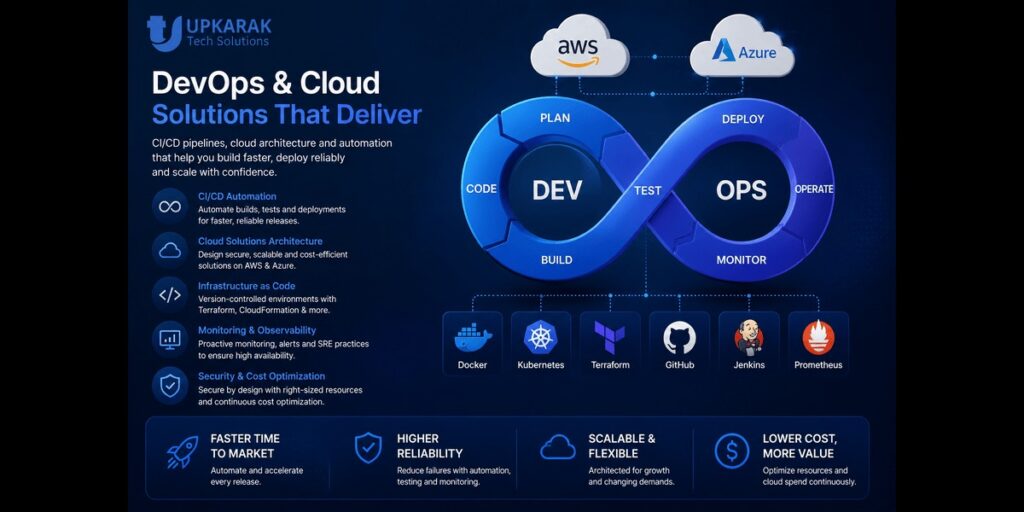
A DevOps services company designs, automates, and manages the pipeline that takes your code from a developer’s laptop to a live production environment, reliably and on a schedule you control. In practice, that means CI/CD pipeline setup, cloud solutions architecture on AWS or Azure, infrastructure as code, monitoring, and cloud migration services, delivered by a team that also advises on which tools and cloud providers fit your business.
If you’re comparing DevOps consulting firms, this guide covers what the work actually includes, how AWS and Azure DevOps services differ, what a CI/CD pipeline setup looks like step by step, what cloud migration services should cover, and a practical checklist for choosing a partner.
What Is a DevOps Services Company?
A DevOps services company combines three things under one roof: engineering (build and release automation), architecture (how your systems are designed to run in the cloud), and operations (keeping everything monitored, secure, and scalable once it’s live).
Most DevOps consulting engagements cover some combination of:
- CI/CD pipeline setup, so every code change is automatically built, tested, and deployed
- Cloud solutions architecture, designing how your applications, databases, and networking fit together on AWS, Azure, or a hybrid setup
- Infrastructure as code, so environments are version-controlled and reproducible instead of configured by hand
- Cloud migration services, moving existing workloads from on-premises servers or one cloud to another
- Monitoring and incident response, so issues are caught before customers notice them
- Cost and security governance, keeping cloud spend and access controls under control as the environment grows
The goal across all of it is the same: ship changes faster, with fewer failures, without needing an internal platform team to manage it all.
What Does DevOps Consulting Include?
DevOps consulting usually starts with an assessment of how your team currently builds and ships software, then moves into implementation. A typical engagement looks like this:
- Assessment. Reviewing your current deployment process, tooling, and pain points (slow releases, manual deployments, unreliable environments).
- Architecture design. Mapping out the target cloud solutions architecture, including compute, storage, networking, and security boundaries.
- Pipeline build. Setting up CI/CD pipelines connected to your source control, with automated testing gates before anything reaches production.
- Infrastructure as code. Writing your infrastructure in a tool like Terraform or Bicep so environments can be recreated or scaled without manual work.
- Migration or cutover. If you’re moving from on-premises or another provider, this is where workloads are migrated and validated.
- Monitoring and handoff. Setting up alerting and dashboards, then either handing operations back to your team or continuing as a managed partner.
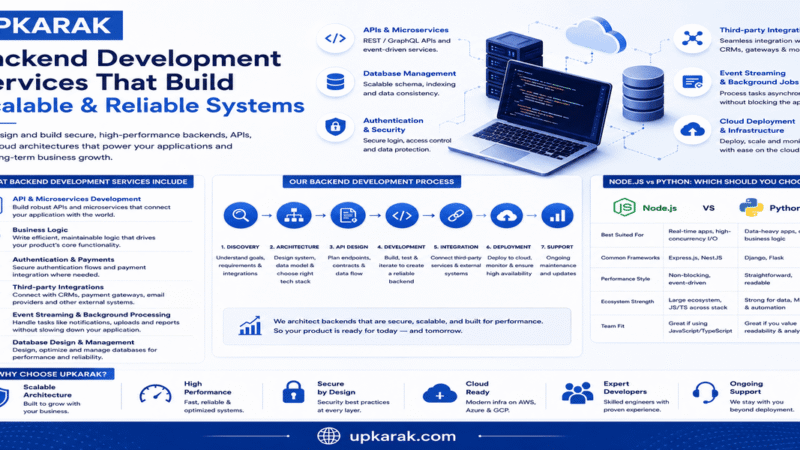
This is the same process Upkarak follows on its DevOps & Solutions Architecture engagements, and it’s often paired with backend development work when the application itself needs changes to support the new pipeline, or with database management and administration when the migration includes moving or re-architecting data stores.
What Is Cloud Solutions Architecture?
Cloud solutions architecture is the blueprint for how your applications, data, and infrastructure are organized in the cloud so they’re secure, scalable, and cost-efficient. It answers questions like:
- Which services should run in containers, and which need a managed database or serverless function instead?
- How is traffic routed and load-balanced across regions or availability zones?
- Where are the security boundaries between public-facing services and internal systems?
- How does the environment scale automatically when demand spikes, and scale back down when it doesn’t?
- What’s the disaster recovery plan if a region or service goes down?
Good cloud solutions architecture is what makes CI/CD pipelines and cloud migration services actually work at scale. A pipeline can deploy code perfectly and still cause an outage if the underlying architecture wasn’t designed to handle the deployment pattern, so the two disciplines are usually delivered together, not separately.
AWS DevOps vs Azure DevOps Services: A Quick Comparison
Both AWS and Azure offer a full set of DevOps tools, but they’re built differently, and the right choice usually depends on where your workloads already live.
AWS DevOps Services | Azure DevOps Services | |
Core CI/CD tools | CodePipeline, CodeBuild, CodeDeploy | Azure Pipelines |
Source control | Integrates with Git-based tools (no native repo) | Native Git repos plus legacy TFVC support |
Project management | Not native, third-party tools required | Azure Boards (Scrum and Kanban built in) |
Infrastructure as code | CloudFormation, or Terraform | ARM templates, Bicep, or Terraform |
Best fit for | Teams building cloud-native apps entirely on AWS, pay-as-you-go pipeline infrastructure | Teams that want an all-in-one suite for planning, source control, and CI/CD across multiple clouds |
Container and serverless support | ECS, EKS, Lambda | AKS, Azure Functions |
Neither platform is universally “better.” Teams already standardized on AWS infrastructure generally get more value from AWS-native CI/CD, while teams that need integrated project management alongside their pipelines, or that run workloads across more than one cloud, tend to lean toward Azure DevOps. A DevOps consulting partner should be able to work in both and recommend based on your existing stack, not their own tooling preference.
How CI/CD Pipeline Setup Works, Step by Step
CI/CD pipeline setup is the part of DevOps consulting most teams notice first, because it directly changes how often and how safely you can ship. Here’s the typical build sequence:
- Connect source control. The pipeline is triggered automatically whenever code is pushed or a pull request is merged.
- Automate the build. Code is compiled or packaged the same way every time, removing “it worked on my machine” problems.
- Run automated tests. Unit tests, integration tests, and security scans run before any code moves forward, catching issues early.
- Deploy to staging. A production-like environment where changes are validated before customers see them.
- Gate the release. Manual approval, automated checks, or both, depending on how much risk a change carries.
- Deploy to production. Using a strategy like blue-green or canary deployment to limit the blast radius if something goes wrong.
- Monitor and roll back if needed. Automated alerts and a fast rollback path if the new release causes errors.
According to Google’s 2025 DORA State of DevOps research, only 16.2% of organizations currently deploy on demand (multiple times per day), while 23.9% still deploy less than once a month, so there’s a wide gap between where most teams are and what a well-built CI/CD pipeline makes possible (DevOps.com). That gap is usually the clearest sign it’s time to bring in a DevOps services company rather than keep patching the deployment process internally.
What Do Cloud Migration Services Cover?
Cloud migration services move your applications, data, and infrastructure from on-premises servers, or from one cloud provider to another, without unplanned downtime or data loss. A properly scoped migration typically includes:
- Dependency mapping. Understanding what talks to what before anything moves, since this is consistently the biggest blocker in migration projects
- Migration strategy selection. Rehost (“lift and shift”), replatform, or fully re-architect, chosen based on cost, timeline, and how much of the legacy system needs to change
- Data migration and validation. Moving databases and files with checksums or reconciliation steps to confirm nothing was lost or corrupted
- Cutover planning. A rollback plan in case the migration needs to be reversed, and a low-traffic window for the final switch
- Post-migration optimization. Right-sizing resources and tuning costs once the workload is running in its new environment
Cloud migration is also rarely a one-time event anymore. Flexera’s 2026 State of the Cloud Report found that 89% of organizations now use more than one cloud provider, and understanding application dependencies remains the single biggest barrier teams report when migrating workloads (Flexera). That’s exactly why dependency mapping is the first step, not an afterthought, in any migration Upkarak scopes.
How to Choose the Right DevOps Services Company
Not every DevOps consulting firm is a fit for every business. Use this checklist when evaluating a partner:
Criteria | What to Look For |
Cloud coverage | Hands-on experience with AWS and Azure, not just one platform |
CI/CD track record | Can show real pipelines they’ve built, not just describe the process |
Architecture depth | Can explain trade-offs (cost vs. resilience vs. speed), not just recommend “best practices” |
Migration experience | Has run dependency mapping and cutover planning on live systems before |
Security posture | Builds access controls and monitoring in from the start, not bolted on later |
Communication | Gives you a clear scope, timeline, and handoff plan up front |
Post-launch support | Offers ongoing monitoring or a documented handoff, not a “drop and go” |
Ask for a specific example of a pipeline or migration they’ve delivered, including what went wrong and how they handled it. Any experienced team will have a real answer to that question.
Why Businesses Choose Upkarak for DevOps & Solutions Architecture
Upkarak is a full-service IT company that pairs DevOps & Solutions Architecture with backend development, database management, and web development, so pipeline and architecture work is designed around the application it supports, not treated as a separate project. That combination is also why clients like Kanexpro and TODPro have worked with the team across multiple projects rather than a single engagement, as covered in the Upkarak portfolio.
If your current deployments are manual, slow, or risky, or you’re planning a cloud migration and don’t have dependency mapping done yet, that’s the point to bring in a DevOps services company rather than keep absorbing the risk internally. You can see the full scope of services on the DevOps & Solutions Architecture page or get in touch to talk through your current setup.